Impact
What impact does Reflective Groundings create?
Reflective Groundings supports both individual practice and organisational culture.
Participants report:
- Feeling more supported and less isolated
- Increased self-awareness and emotional processing
- Greater ability to name and navigate power and complexity
- More thoughtful, equity-informed decision-making
- Improved relationships with partners and communities
- Stronger boundaries and reduced burnout
Over time, this contributes to healthier organisational cultures and more relational, trust-based approaches to funding and practice.
Reflective Frameworks & Practice Models
The following diagrams have been developed to help illustrate the emotional, relational and systemic dynamics that shape equity-focused work. Together, they offer a visual language for understanding how reflective supervision can support individuals, teams and organisations to engage with complexity in more thoughtful, grounded and sustainable ways.
These frameworks draw on reflective practice, systems thinking and equity-informed approaches to explore how care, power, relationships and organisational culture influence decision-making and practice.
Holding Complexity Model
The Holding Complexity Model highlights the multiple emotional, relational and systemic pressures that practitioners and grant managers navigate within racial and health equity work.
The diagram demonstrates how individual experiences are shaped by organisational dynamics, power structures, institutional expectations and wider social inequities.
The model makes visible the often unseen labour involved in equity-focused work and positions reflective supervision as a supportive space for processing complexity, strengthening boundaries and engaging with practice in more grounded and sustainable ways.
The Relational Equity Practice Cycle
The Relational Equity Practice Cycle demonstrates how reflective practice supports ongoing learning, accountability and equity-informed decision-making.
The model shows reflection as a continuous process that strengthens awareness of power, identity and relationships, leading to more thoughtful action, deeper trust and healthier organisational cultures.
Rather than viewing equity as a fixed outcome, the cycle positions it as an ongoing relational practice rooted in reflection, learning and adaptation.
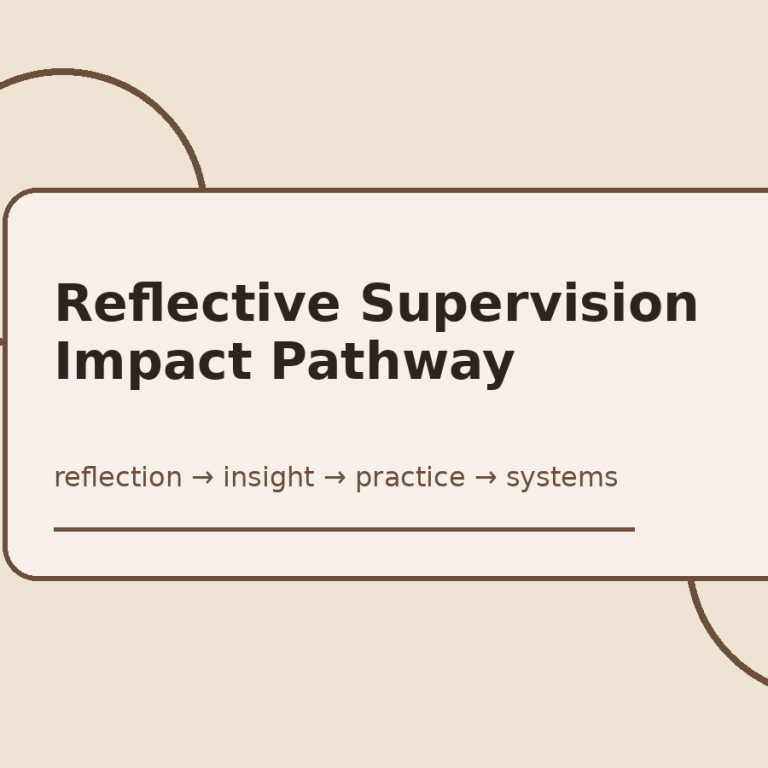
Reflective Supervision Impact Pathway
The Reflective Supervision Impact Pathway illustrates how reflective spaces can create change across individual, relational, organisational and systemic levels.
The model shows how providing structured opportunities for reflection and emotional processing can strengthen wellbeing, deepen self-awareness and support more thoughtful, equity-informed practice.
Over time, these shifts contribute to healthier organisational cultures, stronger relationships and more relational and just approaches to decision-making and systems change